
Sodium hydroxide
Caustic Soda
A strong, highly soluble base that generates heat as it dissolves in water. Used as a core raw material in soap, detergent, paper, textile and food-processing industries.
01
Product summary
A strong, highly soluble base that generates heat as it dissolves in water. Used as a core raw material in soap, detergent, paper, textile and food-processing industries.
- NaOH
- Molecular formula
- 39.997 g/mol
- Molecular weight
- 1310-73-2
- CAS No.
02
Production methods
-
01
Membrane Cell Electrolysis
Most of today’s global output comes from electrolyzing a saturated brine (NaCl) solution in cells separated by an ion-exchange membrane. Sodium hydroxide and hydrogen form at the cathode while chlorine gas is released at the anode, the membrane keeping the two streams apart.
-
02
Diaphragm Cell Electrolysis
An older method that electrolyzes brine in cells divided by a porous diaphragm. The resulting sodium hydroxide solution is more dilute than the membrane-cell product and is concentrated afterward by evaporation.
-
03
Causticizing (Lime-Soda Process)
Sodium carbonate (soda ash) is reacted with slaked lime: Na₂CO₃ + Ca(OH)₂ → 2NaOH + CaCO₃. This predates the electrolytic route and is now used only on a limited scale.
03
Function & properties
-
Strong base
A solution has a pH around 13, making it one of the strongest and most widely used industrial bases.
-
Hygroscopic
Readily absorbs moisture from the air; an exposed surface picks up humidity and begins to dissolve over time.
-
Exothermic dissolution
Dissolving in water releases heat quickly; a solution can reach around 50°C within a few minutes.
-
Caustic and corrosive
Direct contact with skin, eyes or the respiratory tract causes serious irritation and burns, so protective equipment is required when handling it.
-
High solubility
Dissolves readily in water, ethanol and methanol, forming a slippery, soap-like solution.
-
Saponifies fats
Reacts with fats and oils to yield glycerin and soap (the saponification reaction) — the basis of soap manufacturing.
04
Applications
- Soap and detergent manufacturing
- Drain cleaning
- Textiles (bleaching, rayon production)
- Pulp and paper
- Chemical manufacturing (sodium aluminate, silicate, zeolite)
- Food processing (oil refining, olive processing, cocoa, confectionery)
- Pharmaceuticals
- Mining and oil/gas processing
- Water treatment
Full technical description
What is caustic?
Caustic Soda, also known as sodium hydroxide, has the chemical formula NaOH.
In English it is known as Caustic Soda. Caustic means caustic and corrosive. It reacts with the skin in direct contact with the skin. It is a moisture-attracting substance in white color.
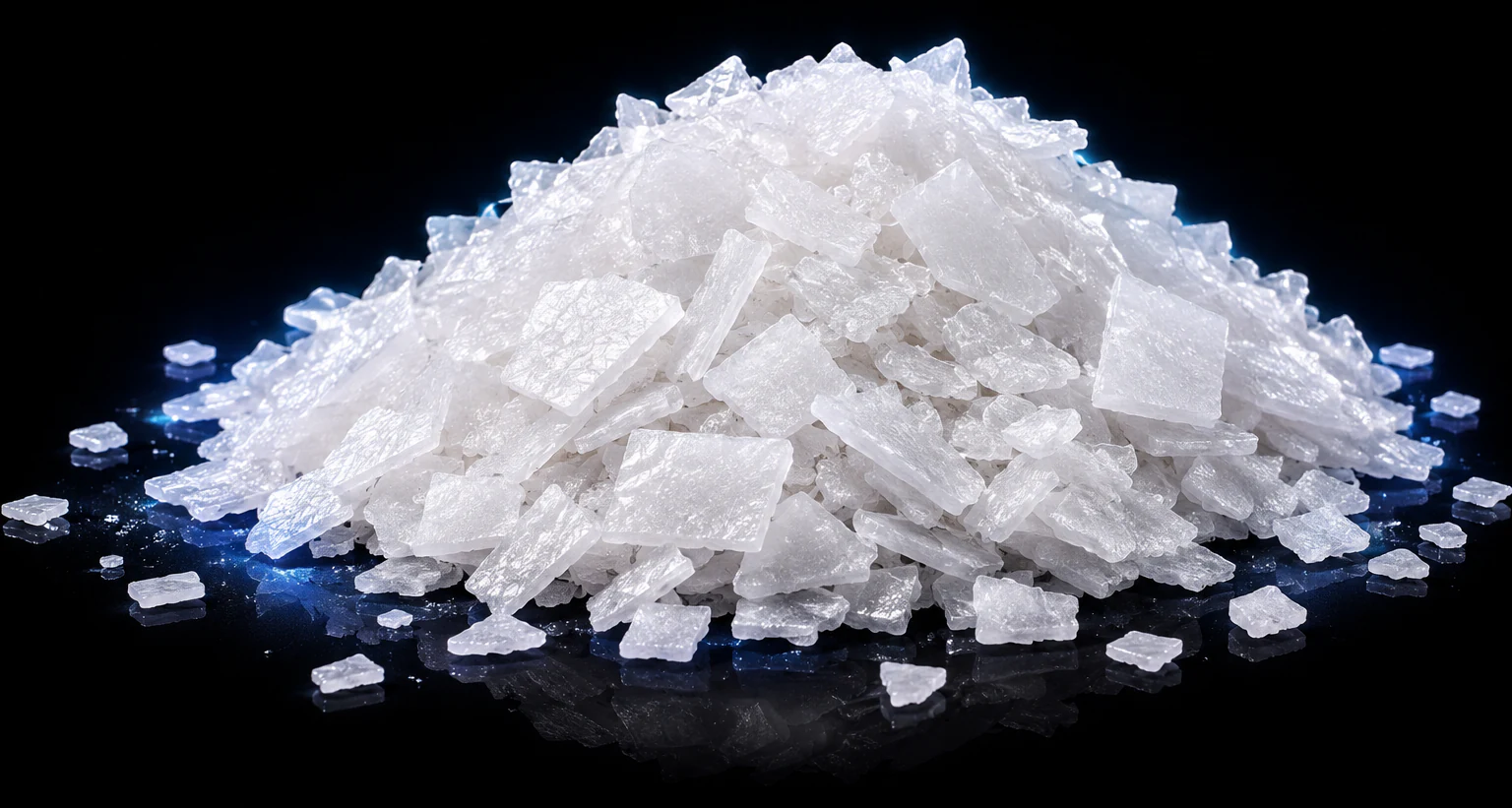
It is a basic compound used in chemistry and many industries. Caustic soda, which has no odor, dissolves easily in water and turns into a soft and slippery solution that feels like soap. It exists in liquid or solid form, the solid form in the form of sequins and beads, and the liquid form in the form of an aqueous and slippery solution. Although it is not known how, caustic was discovered by Humphrey Day in 1807. Caustic, which has an itching effect when touched with bare hands, does not occur naturally but is very easy to produce.
| Molar mass | 39.997 g/mol |
|---|---|
| Formula | NaOH |
| Density | 2.13 g/cm³ |
| PH | 13 |
| IUPAC ID | Sodium oxidanide, Sodium hydroxide |
| Soluble in | Water, Ethanol, Methanol |
Usages of Caustic Soda
It is one of the raw materials of the soap we know. Glycerin and soap are produced from the reaction of caustic soda and oil. At the same time, sink openers are actually nothing more than the caustic soda we know. Used in laboratories to capture acidic gases, caustic soda is used in industry to make many chemicals and in oil refineries. In contact with water, it raises the temperature to 50 degrees within 5 minutes and maintains this temperature for approximately 15 minutes. Let's examine in detail the places where caustic is used ...
Labo
It is used in sewage and treatment plants for cleaning pipes, removing bad odors and acid control. Caustic drain opening is frequently tried in our country and it is a dangerous job. Caustic acid is an acid-based material and a very good disinfectant at the same time. When combined with water, it releases heat and is caustic. Caustic Soda, which can cause serious damage to the skin, eyes and respiratory tract, should be used with goggles and gloves and its odor should never be inhaled. In some sources, it is written to be used for various purposes at home, but caustic is classified as dangerous and chemical substances and it is recommended to keep it away from the home environment. It is very prone to react with water. Flame and heat may occur in reaction with water.
Textiles
In addition to being used to remove residues and bleach the final product, it is also used to make artificial silk.
Paper
Caustic Soda is used in the paper industry as an adhesive, in heat printing and in newsprint. It is one of the indispensable ingredients in the production of paper and pulp.
●Chemical
In material production; it is used in the production of sodium aluminate, sodium cyanide, silicate, polycarbonate, titanium oxide and zeolite.
Detergent
Caustic Soda is used in the detergent industry to make sodium hypochloride, soap, oven and pipe cleaners.
In the food sector
Caustic Soda is used to increase edible oil, to chemically peel fruit and vegetable skins, to soften and darken olives in olive processing, in chocolate and cocoa processing, in caramel and soft drink production and in thickening ice cream. It is also used in the beverage and dairy industry for degreasing, water treatment and equipment cleaning.
In the pharmaceutical industry
Caustic Soda is used in the production of aspirin and antiseptics.
● In Mining
It is used to clean the acid unit in filters and mines. It is also used in oil exploration and natural gas processing; cleaning acid residues in refinery products, removing phenols, pH balancing in drilling mud. Things to Consider When Using Caustic
1) Caustic Soda reacts and dissolves when combined with boiling water. As the caustic soda dissolves, it will emit a toxic vapor and splash around. The caustic solution is extremely harmful and caustic. Therefore, people who want to use caustic soda should wear gloves, goggles and a mask.
2) The vapor produced when caustic soda is mixed with water should not be inhaled through the nose.
3) No open areas of skin should remain when using caustic.
4) If caustic fluid comes into contact with the skin, burns and irritation will occur. In case of skin contact with caustic soda, all clothing should be removed and the area where the caustic soda has come into contact should be placed under running water for 15 minutes. All clothing should also be washed in boiling water.
5) Permanent eye damage may occur when caustic soda comes into contact with the eyes. For this reason, goggles must be worn when using caustic soda. In case of eye contact with caustic soda, keep the eyelids open and rinse with cold water for at least 15 minutes.
6) Small operations such as sink and toilet drains can be done by the person by taking caustic. However, professional companies should be consulted for cleaning large drains such as pipe installations. Professional plumbing companies will completely open the drains without causing any damage by using special caustics and professional devices.
7) If caustic soda is used too much, it will melt the drain pipes and the seals at the joints. For this reason, an installation company should be consulted for more than one use of caustic soda.
Note: Use in the home environment carries health and safety risks.
05
Technical details
- Molekül formülü
- NaOH
- Molekül ağırlığı
- 39.997 g/mol
- CAS No
- 1310-73-2
Frequently asked
Is caustic soda the same as sodium hydroxide?
Yes. Caustic soda is the common name for sodium hydroxide (NaOH); both terms refer to the same compound.
Why is it called "caustic"?
The name comes from its corrosive, burning action on contact with skin and other tissue — caustic literally means burning or corrosive.
Why does it heat up when mixed with water?
Dissolving NaOH in water is an exothermic reaction; the heat released raises the solution’s temperature quickly.
Does it come as a solid or a liquid?
Both. The solid form is sold as flakes or beads, while the liquid form is an aqueous, slippery solution.
What should be considered when storing and transporting it?
Because it is hygroscopic and corrosive, it should be kept in sealed, moisture-proof containers and handled with equipment made from resistant materials, along with appropriate protective gear.
Is it safe to use in food processing?
Under controlled, regulation-compliant dosing it is used in processes such as olive curing or pretzel production; in concentrated form it remains a caustic chemical not intended for direct consumption.
Request
Request a quote
Tell us what you need. Our team will get back to you shortly.
Quote request for Caustic Soda
- Molecular formulaNaOH
- Molecular weight39.997 g/mol
- CAS No.1310-73-2
