
Sal ammoniac
Ammonium Chloride
A white, crystalline salt that is highly soluble in water, forming slightly acidic solutions. Widely used in dry battery production, galvanizing, textile dyeing, fertilizers and pharmaceutical manufacturing.
01
Product summary
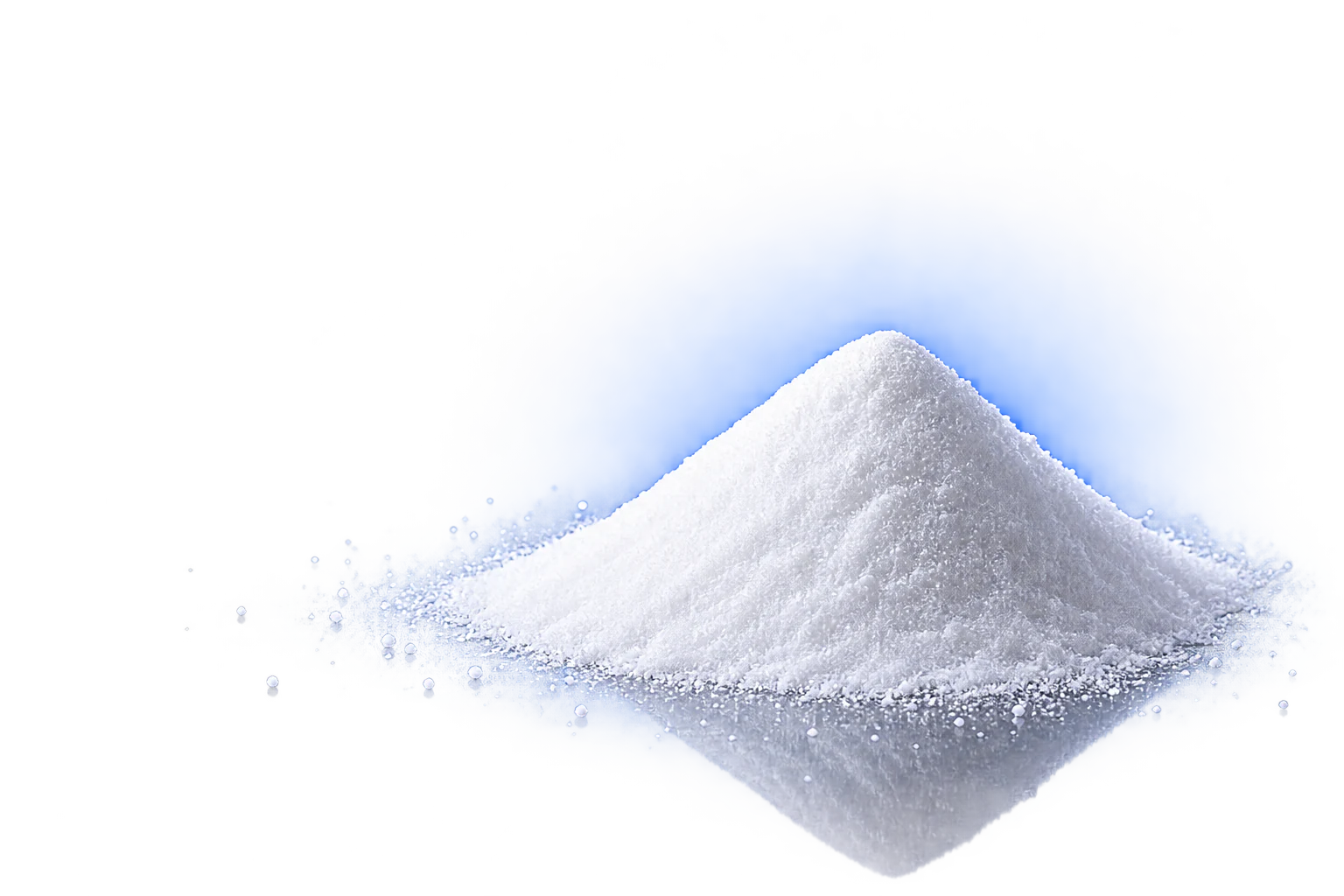
A white, crystalline salt that is highly soluble in water, forming slightly acidic solutions. Widely used in dry battery production, galvanizing, textile dyeing, fertilizers and pharmaceutical manufacturing.
- NH₄Cl
- Molecular formula
- 53.49 g/mol
- Molecular weight
- 12125-02-9
- CAS No.
- White solid
- Form
- 25 kg bags
- Packaging
02
Production methods
-
01
Direct Neutralization
Produced by reacting ammonia with hydrochloric acid (NH₃ + HCl → NH₄Cl); product purity and yield depend directly on reaction conditions, with temperature and feed ratio kept under control.
-
02
Solvay By-product
Ammonium chloride released during soda ash production (the Solvay process) is recovered by crystallization; a significant share of world output comes from this route.
-
03
Double Decomposition
Produced by the metathesis reaction of ammonium sulfate with sodium chloride in solution; the difference in solubility is exploited, and the product is crystallized by cooling.
03
Function & properties
-
High solubility
Highly soluble in water; this is the key property that allows it to be easily melted and used in hot metallurgical processes.
-
Slightly acidic
Its aqueous solutions are slightly acidic in character; this property is exploited in electrolytic battery and soldering applications.
-
Endothermic dissolution
Its heat of dissolution is endothermic; it draws heat from its surroundings as it dissolves, noticeably lowering the temperature.
-
Soldering flux
Cleans the oxide layer from metal surfaces at high temperature; used as a flux in galvanizing and tin plating.
-
Dye leveling agent
Helps dye distribute more evenly across fabric and speeds up drying in the dyeing industry.
-
Hygroscopic
Absorbs moisture from the air; needs to be stored in a sealed, dry environment to prevent caking.
04
Applications
- In the production of dry batteries.
- In the galvanizing industry for tin plating, in hot-dip galvanizing as a flux material, In the cosmetic industry for shampoo production as an surfactant if ALS is used.
- Ammonium Chloride is used to thicken the shampoo, and in the production of some cleaners,
- For refining some base metals (such as gold),
- In drying some synthetic adhesives,
- In hardening urea formaldehyde resins (used in the MDF industry) and in the production of particle board adhesives.
- Raw materials and auxiliary materials used in the production of particle board / MDF are listed below:
- Wood (beech, poplar, and larch) Cotton stalk, Urea
- formaldehyde glue,
- Polyvinyl acetate glue,
- Ammonium chloride (33%). (used by dilution) In the pharmaceutical industry, it is used as an adjuvant (an adjuvant is a substance in a prescription that helps to produce the effects of other drugs),
- as an expectorant in cough syrups,
- and is used for its diuretic properties.
- In the textile and leather industry,
- in dyeing, printing, and polishing cotton, In the production of soldering tin used for soldering , (The ammonia (NH3) and hydrochloric acid (HCl) produced from the decomposition of salt removes the oxide layer that has formed on the surface of the metal, making the metal suitable for soldering).
- In the feed industry, it is used as a food additive to prevent urinary stones in cattle, Lack of water consumption, imbalanced calcium-phosphorus in feed, and lack of vitamin A can cause urinary stones in cattle. When there is a problem with urinary stones, feed and water analyses should be performed.
- Using trickle irrigation with dams, adjusting the calcium-phosphorus balance in the feed, adding sodium chloride (salt) and ammonium chloride to the ration can prevent urinary stones. Used in fertilizer production.
- Used as a food additive in yeast production.
- Used in the production of liquor and spirits in some countries.
- Used as an energy source for microorganisms' biological applications.
- Used as a food additive (used in the production of a type of candy known as both sweet and salty in Europe and America)
Full technical description
What is Ammonium Chloride?
Ammonium chloride, with the chemical formula NH4Cl, is a white, crystalline salt that is highly soluble in water. Its solutions are slightly acidic. It is found in the vicinity of some volcanic vents in its mineral form. This substance is used as a flavoring agent in some types of candies. Ammonium chloride is produced by the reaction between hydrochloric acid and ammonia.
This chemical is commonly known as Sal Ammoniac. It is a type of salt with a crystal structure.
Sal Ammoniac has various uses. For example, Sal Ammoniac is used in small amounts as a nitrogen-containing fertilizer, it is used in the manufacture of dry batteries found in the market, in the textile industry, in various chemical laboratories, in the leather industry and also in the Solvay method.
Ammonium Chloride is a type of salt that is purified at 340 degrees. It is also used in soldering, electrolyte batteries, in the dyeing industry and in the analysis of chemicals.
Product Appearance: White solid
Formula: NH4Cl
Packaging: 25 kg bags
Chemical name: Ammonium chloride
05
Technical details
- Molekül formülü
- NH₄Cl
- Molekül ağırlığı
- 53.49 g/mol
- CAS No
- 12125-02-9
- Form
- White solid
- Ambalaj
- 25 kg bags
Frequently asked
Is Sal Ammoniac the same as ammonium chloride?
Yes. Sal Ammoniac is the common name for ammonium chloride; both refer to the compound NH₄Cl.
Which industries use it?
Textile and dyeing, fertilizers, electronics (dry batteries), metallurgy and galvanizing are its main application sectors.
Why does its solubility in water matter?
High solubility allows it to be easily melted and incorporated into hot metallurgical processes.
Is it used as a food additive?
In some countries it is used under the code E510 as a dough conditioner and in salty licorice-type confectionery. Food-grade use is subject to relevant regulations.
How should it be stored?
Because it is hygroscopic, it should be stored in sealed packaging in a dry, cool environment; moisture uptake leads to caking.
What should be considered when handling it?
The work area should be well ventilated and appropriate safety equipment used; consult the product’s safety data sheet for detailed guidance.
Request
Request a quote
Tell us what you need. Our team will get back to you shortly.
Quote request for Ammonium Chloride
- Molecular formulaNH₄Cl
- Molecular weight53.49 g/mol
- CAS No.12125-02-9
- FormWhite solid
- Packaging25 kg bags
